General information only. Does not consider your personal situation.

"Nothing's changed. Same properties, same family. So why is the answer no?"
It's a question I've heard more than once from accountants and advisers. Here's one deal that answers it.
The deal: $30 million, and seven properties read one at a time.
Anonymised scenario. Details changed. Figures rounded.
The need. A family group with seven inner-city retail and office properties held across several trusts, worth about $47 million, with about $27 million of debt. Alongside the portfolio, they'd run a trading business for about 20 years. They wanted to refinance to $30 million and release equity for other investments.
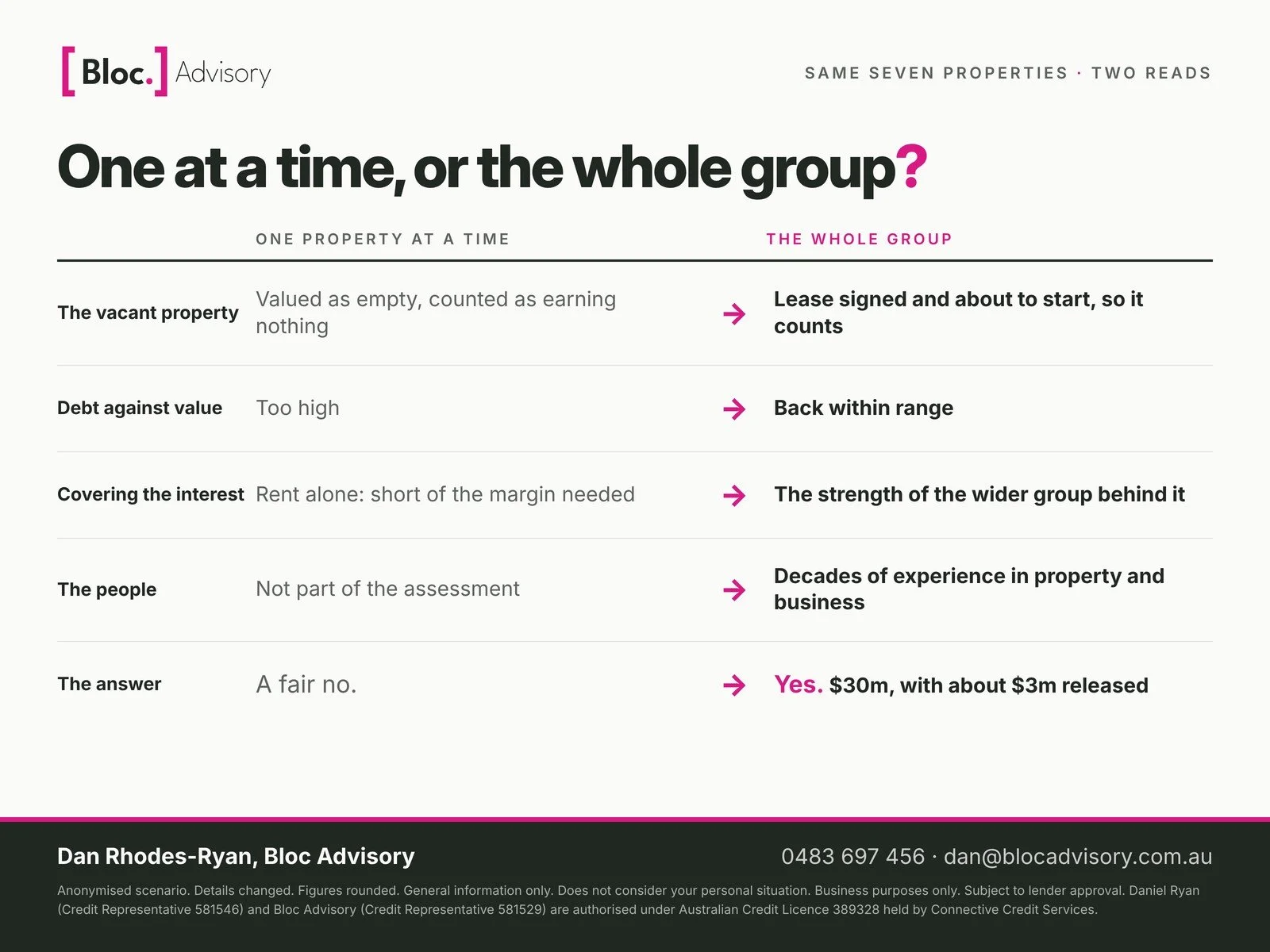
The block. Their lender assessed the request one property at a time. One property was vacant when it was assessed, so it counted for nothing, even though a new lease had been signed and was about to start. On that read, the debt looked too high for the value and the rent didn't cover the interest by enough. On those numbers, no was a fair answer.
The fix. The properties weren't the problem. The way they were being read was. So the request stopped being seven separate properties and became one group: a lease that was signed but not yet started, a trading business with two decades of history sitting right next to the property, and owners who'd been through more than one cycle. The deal was structured around the strength of that whole group, not just the rent roll.
There's a trade-off in structuring it that way. The family weighed it up with their accountant before anyone signed, and it's exactly the conversation I'd want an adviser in the room for.
The outcome. Approved at $30 million, releasing about $3 million for other investments. Same family, same seven properties, a different read.
Why I read these deals the way I do.
I spent 16 years on the lending side, most of it with credit delegations. A credit team reads the file it's given. If the file shows seven properties and a vacancy with no broader context, that's what gets judged.
My approach is to make sure the file shows the whole picture. Whether it's a family buying the premises their business runs from or a group refinancing a portfolio, the assets are only part of the story.
The numbers start the conversation. The context finishes it.
Three signs a client's property is being read too narrowly.
They've been told no, or capped, on a refinance or equity release, even with solid holdings.
A property is vacant, or a new lease is about to start.
There's a trading business or other income that's never been part of the conversation with their lender.
None of these mean a lender will say yes. They mean the file may only be telling half the story.
Where to start.
If you advise clients with property across several entities, or you're in this spot yourself, it's worth a conversation before the next application goes in. A lender will always see the assets. I help them see the whole picture.
If that approach could help your client, let’s talk.
Dan
Call 0483 697 456 or email dan@blocadvisory.com.au
Important information
General information only. Does not consider your personal situation. Anonymised scenario: details have been changed and figures rounded. It isn't a quote or an indication of what any lender will offer. Business purposes only. Subject to lender approval. Fees and charges apply. Daniel Ryan (Credit Representative 581546) and Bloc Advisory (Credit Representative 581529) are authorised under Australian Credit Licence 389328 held by Connective Credit Services.