General information only. Does not consider your personal situation.
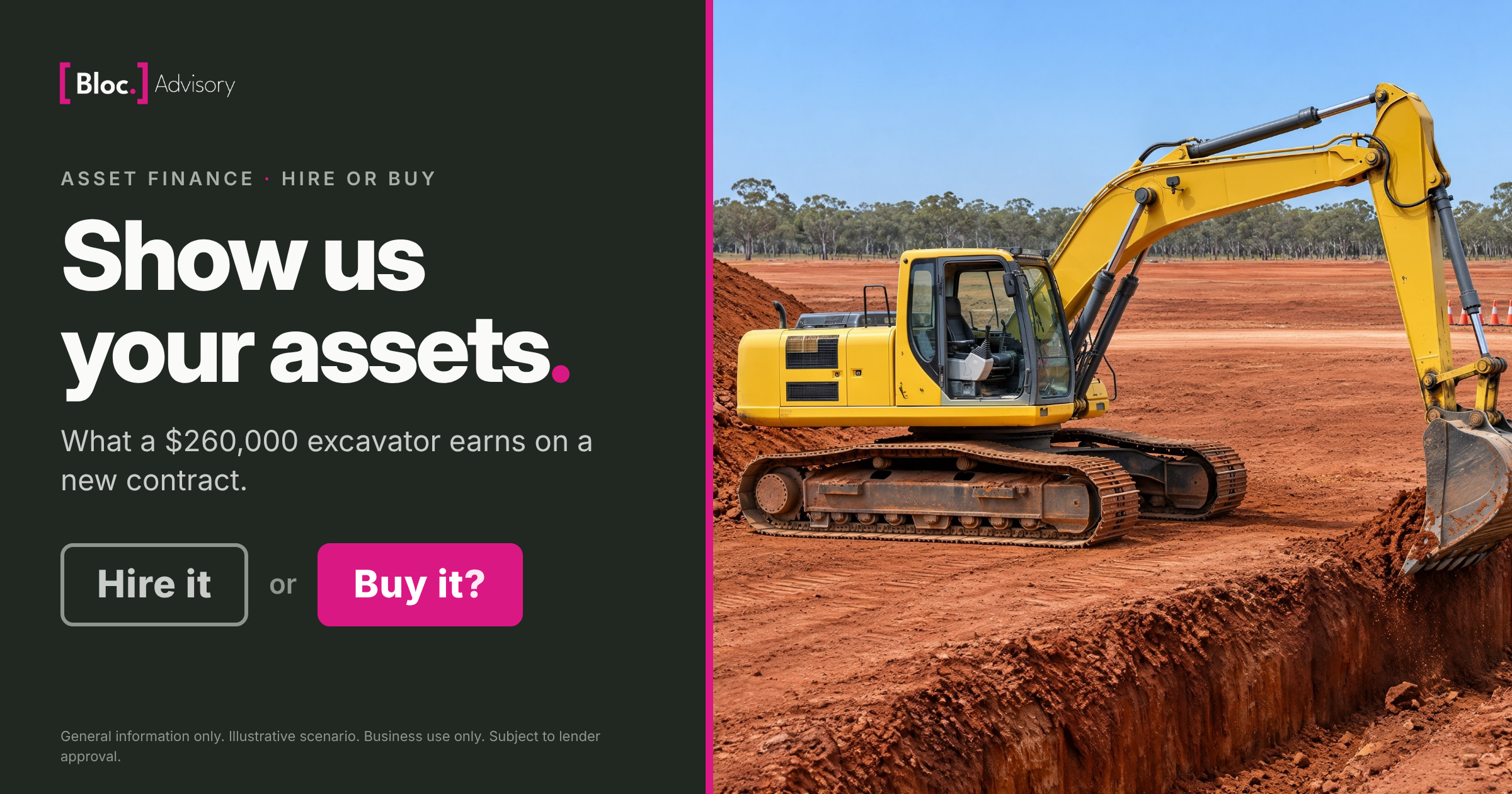
"We've won it. Now we need the machine."
It's one of my favourite calls to get. The contract's signed, the start date's eight weeks away, and somewhere in the schedule is a line that assumes a 20-tonne excavator on site four days a week for a year.
The first question is usually "can we afford a $260,000 machine?" The better question is "how do I keep more of the money that machine earns?
Meet the business.
Illustrative scenario. Details changed.
A civil and drainage contractor in Melbourne's west. Eight staff, a good name with local builders, and they've just won a 12-month subcontract on a residential subdivision worth $1.4 million.
The excavator work alone runs to about 180 days on site. At eight hours a day, that's 1,440 machine hours.
What the machine earns on this job.
Wet hire for a 20 to 25 tonne excavator, with an operator, starts at around $170 an hour plus GST. That's roughly what a machine and operator is worth in the contract.
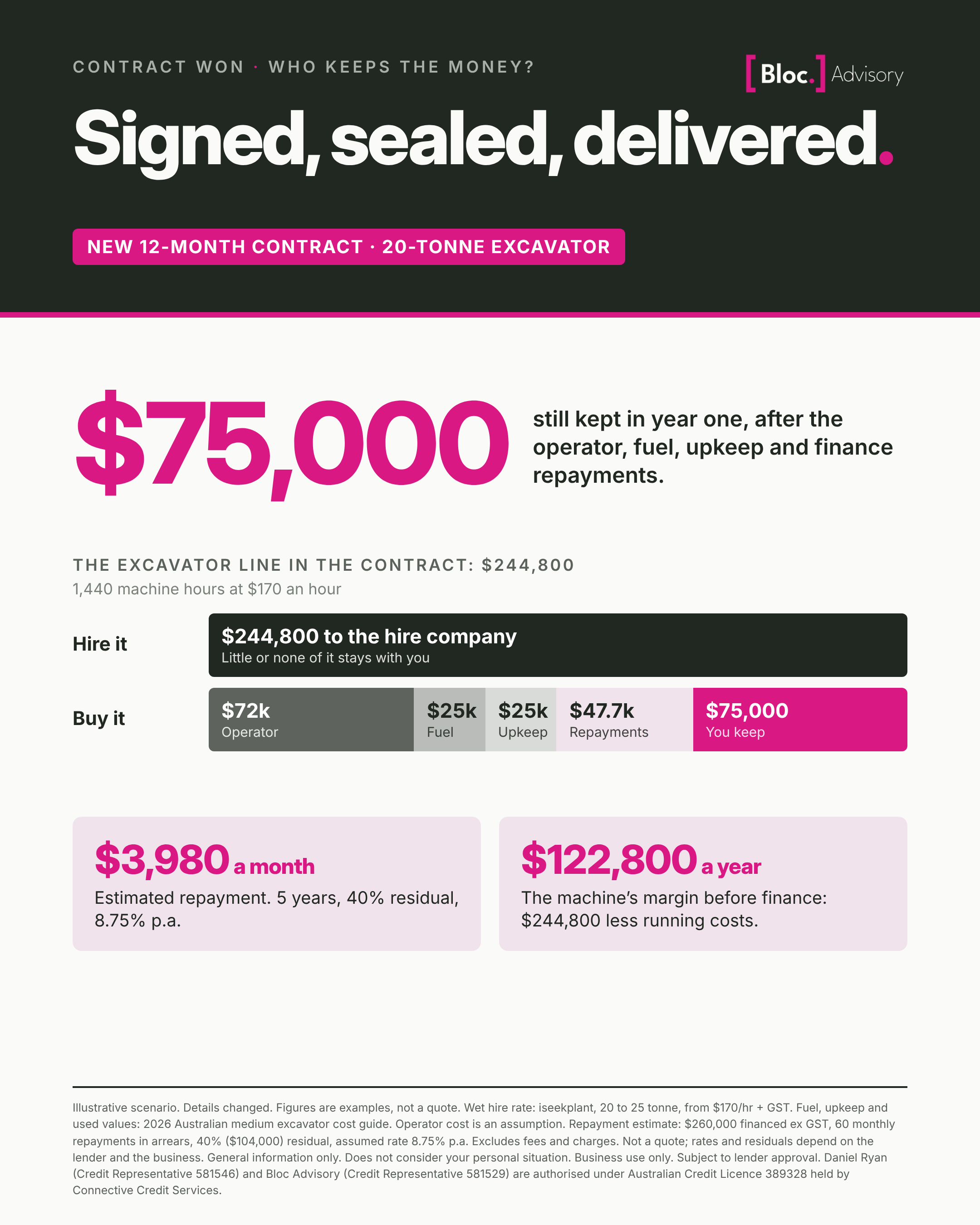
1,440 hours × $170 = $244,800 a year.
There are two ways to deliver it.
Option one: hire it in.
Book a wet-hire machine and operator from a plant company for the year. The work gets done, but most of that $244,800 goes straight back out to the hire company, plus a float at around $650 each way every time the machine moves.
The business delivers the job. Little or none of the excavator money stays with it.
Option two: own it.
Buy the machine and put your own operator in it. New excavators in the 15 to 22 tonne class typically sell for $180,000 to $280,000 in Australia. This one's quoted at $260,000 ex GST.
Here's what it costs to run for the year:
Operator: $72,000. 1,440 hours at about $50 an hour all in (wages, super, workers comp). That's an assumption; use your own payroll figure.
Fuel: $25,000. Fuel for this class typically runs $18,000 to $35,000 a year.
Upkeep: $25,000. Servicing ($8,000 to $18,000), undercarriage wear ($4,000 to $12,000) and insurance ($2,000 to $5,000).
The sum that matters.
$244,800 earned, less $122,000 to run it, leaves $122,800 a year. That's about $10,200 a month to cover the finance and keep as margin.
If the finance comes in under $10,200 a month, the machine pays for itself out of this one contract, and everything above that is the business's to keep.
Whether it comes in under depends on the deposit, the term, any balloon and the rate on the day. That's the part I work out with you, not a number I'd put in a blog.
What the repayments might look like.
Here's one way to set up the finance. These are assumptions, not a quote:
$260,000 financed, ex GST
5 years, 60 monthly repayments
A 40% residual, so $104,000 is left to pay at the end
An assumed rate of 8.75% p.a. Published rates for construction and earthmoving equipment sat between about 7% and 10% in October 2026, depending on the lender, the business and the machine
That comes to about $3,980 a month, or around $47,700 a year, before fees and charges.
Take that from the $122,800 and the business still keeps about $75,000 in year one, from a machine it didn't have last month.
Two things to know about that structure. The residual keeps the repayments down, but $104,000 is still owed at the end of year five, so it's paid out, refinanced or covered by selling the machine. And 40% is on the high side for earthmoving gear over five years; some lenders will cap it lower. At 30%, the same loan is about $4,325 a month.
The right mix of deposit, term and residual depends on the business, the lender and what you want to own at the end. That's the part I work out with you.
What the contract really buys you.
The dollars are only part of it.
You control the program. No booking a fortnight out, no waiting on a float, no machine pulled off your job for someone else's.
You can price the next job sharper. When the machine is yours, you know exactly what an hour costs you.
You still own something at the end. Used excavators in the 10 to 30 tonne class sell for $60,000 to $180,000, depending on age and hours. Hire receipts are worth nothing.
Where it doesn't stack up.
To be fair to the hire yard: owning isn't always the answer.
The contract is short. A three-month job rarely carries a $260,000 machine on its own.
Nothing lined up after. The sums above cover one year. Year two needs work too.
Cash is tight at the start. Progress payments can lag the work, and a new repayment starts straight away.
The wrong machine. If the next job needs a 30-tonne, a 20-tonne bought for this one won't help.
Why I read these deals the way I do.
I spent 16 years on the lending side, including time with credit delegations. The first question a credit team asks on equipment is simple: what will it earn?
A new contract answers that better than almost anything: Work that's already won, a machine that delivers it, and the sums showing what's left over. That's a business case, not a wish list. You don't need to send me the contract to get started, but if you've got one, it tells the story for you.
Every set of numbers has a person behind it. Here, it's an owner who's just won the biggest job of their year and wants to keep more of the reward in their own account.
Show us your assets.
If you're weighing up a machine, a truck, a ute or anything else for the business, send me three things:
Your ABN
A copy of the order or invoice
A line or two on what it'll do for your business
Within one business day, you'll know where you stand. Bloc arranges asset finance for business owners anywhere in Australia.
Dan
Call 0483 697 456 or email dan@blocadvisory.com.au
Sources
iseekplant, Excavator and digger hire rates guide: 20 to 25 tonne wet hire from $170 an hour + GST; float from $650 each way. Accessed 17 November 2026.
Medium excavator running costs Australia 2026: new prices by class, fuel, servicing, undercarriage, insurance and used values. Accessed 17 November 2026.
Important information
General information only. Does not consider your personal situation. Illustrative scenario only: figures are examples, not a quote, and your costs will differ. Business use only. Subject to lender approval. Fees and charges apply. Speak to your accountant about the tax treatment of any equipment purchase.
Daniel Ryan (Credit Representative 581546) and Bloc Advisory (Credit Representative 581529) are authorised under Australian Credit Licence 389328 held by Connective Credit Services.