What's really behind the inflation headlines, and what to check before the RBA's November decision.
When the September inflation figures landed, I went past the headline and into the ABS data. After 16 years on the bank side of the desk, that's usually where the real story is.

The headline came in hotter than expected, and markets now see another rate rise on Tuesday 3 November as likely. But the more useful story sits underneath it, and it's why every borrower, business or household, should be looking at their cash flow now rather than after the decision.
What the headline number hides.
Headline inflation rose to 4.3% in the 12 months to September, up from 4.0% in August. That number moves around with volatile prices like fuel, which rose 9.4% in September alone.
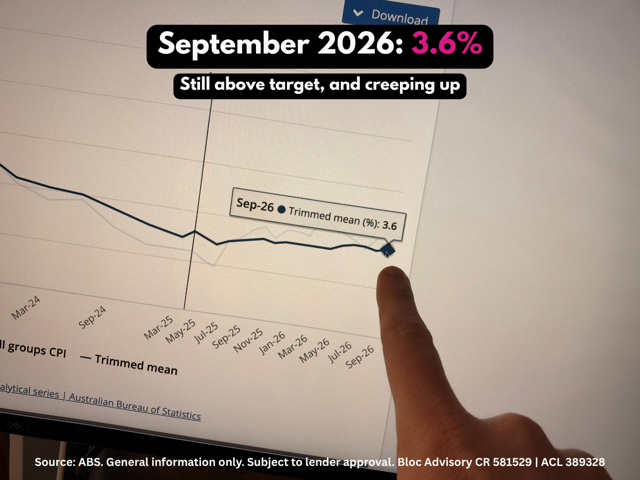
The RBA pays closer attention to the trimmed mean, which strips out the biggest price swings each month. It was 3.6% for the year to September. For the quarter it rose 1.0%, above the RBA's own August forecast of 0.8%.
The telling part is the trend. The trimmed mean went above the top of the RBA's 2 to 3% target band in August 2025, at 3.1%.
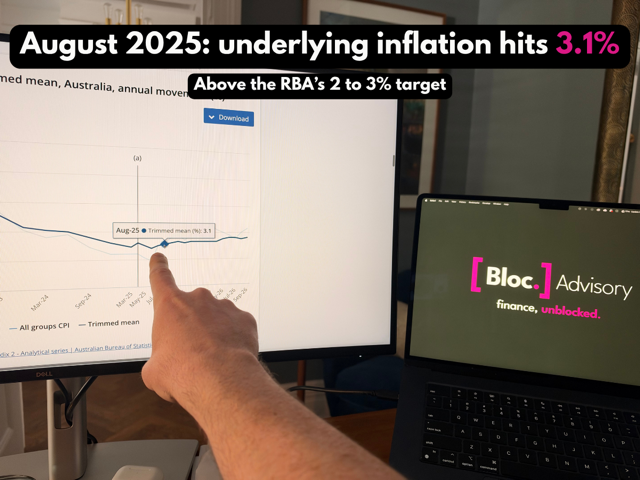
It has stayed above that band every month since, and it reached 3.6% in September 2026. Headline inflation can fall back when fuel does. Underlying inflation hasn't.
Markets moved quickly after the release. Bloomberg data put the chance of a 0.25% rise on Tuesday at about 85%. If it happens, the cash rate goes from 4.60% to 4.85%, the fifth increase of 2026.
What's driving it.
The pressure is coming from costs that don't fall quickly.
Housing. Housing was the largest contributor to annual inflation, up 5.2%. New dwelling prices rose 4.7% as builders passed on higher material and labour costs, and electricity costs rose too.
Local costs. Non-tradable inflation, the part of the basket driven by local conditions rather than imports, was 4.5% in September. Services inflation was 4.1%. Earlier this year, the ABS named electricity, new dwellings and rents as the main contributors.
Demand. RBA Governor Michele Bullock said this week that overall demand continues to outpace supply.
Rents, power bills and building costs don't drop back the way fuel can. That's why the underlying number has been sticky.
Why price rises don't stay in the headlines.
A price rise in one part of the economy rarely stays there. Think of it like a stone dropped in a pond: the splash is the headline, but the ripples keep spreading for months.
A freight company's higher running costs show up in its delivery rates. A tradie's higher travel and material costs show up in their quotes, which flow into the builder's price. A supplier's higher power bill ends up in what they charge you.
For a business, that shows up in supplier invoices. For a household, it shows up in the weekly bills. And it's the reason central banks watch underlying inflation so closely: a spike in one price is easier to look through than rises that have spread across the whole basket.
What to check now.
It's better to know where you stand before Tuesday's decision than after it. Another rise would land on top of four this year already, so these are worth checking now.
Business lending
What another rise does to your repayments and monthly cash flow
Interest cover or other covenant tests in your facility, and how close you sit to them
Upcoming facility reviews, renewals or fixed rate expiries
Home and investment lending
What another 0.25% does to your repayments
When any fixed rate period ends
Whether your current loan still suits your plans
ATO debt
If you have tax debt, or you're weighing up an ATO payment plan, look at how those repayments sit alongside your loan repayments and forecast cash flow. Your accountant is the right person on the tax side. I can help with the lending side.
For accountants and financial advisers.
You're often the first to see a client's cash flow tighten. If a client's loan repayments, covenants or ATO obligations are starting to bite, a lending review can sit alongside the advice you're already giving.
I'm happy to work through scenarios with you and your clients, and to keep you informed throughout.
Talk it through.
If you'd like to work through your position, call Dan on 0483 697 456 or email dan@blocadvisory.com.au.
General information only. It does not consider your objectives, financial situation or needs. Written 29 October 2026, before the RBA's 3 November decision.
Sources
ABS: CPI rose 4.3% in the year to September 2026
ABS: Consumer Price Index, Australia, March 2026
ABC News: Inflation rate rises to 4.3 per cent in September
IndexBox: Australian inflation accelerates to 4.3% in September 2026
EBC: Australia inflation hits 4.3%
FXStreet: Australian dollar strengthens as hot inflation data boosts RBA rate hike bets
Aussie: What experts predict for the RBA's November 2026 decision
Important information
This article is general information only. It does not consider your objectives, financial situation or needs, and it is not tax, legal or financial advice. Any loan is subject to lender approval. Fees, terms, conditions and eligibility criteria apply.
Bloc Advisory (Credit Representative 581529) and Daniel Ryan (Credit Representative 581546) are authorised under Australian Credit Licence 389328.